Education & Times: Interdisciplinary Training as a Foundation for the Digital Finance Ecosystem
16/04/2026
The launch of Vietnam’s international financial centre in Da Nang has created an urgent demand for human capital. Beyond financial expertise, the workforce must integrate capabilities in technology, law and data to meet standards of transparency and compliance in an increasingly globalised environment.
New requirements for the financial workforce
Da Nang aims to welcome around 8.5 million international visitors by 2026, providing a strong boost to tourism and services. This, in turn, requires a transparent and secure financial system capable of meeting the legitimate transaction needs of tourists, investors and international experts.
In this context, digital finance is emerging as a critical layer of infrastructure. From electronic payments and digital identification to digital assets, new technologies are not only expanding the transaction landscape but also imposing higher standards of control and transparency.
According to Nghiem Minh Hoang, a fintech applications expert at the Vietnam Blockchain and Digital Assets Association, the global crypto asset market has surpassed $2 trillion in scale, with more than 600 million users and around 26 million token and coin projects issued, indicating that digital assets are increasingly becoming part of the digital financial infrastructure. Regulatory approaches are also evolving rapidly. Many countries have established legal frameworks and supervisory mechanisms to manage risks and enhance transparency. In Vietnam, the passage of the Digital Technology Industry Law is seen as a step forward in completing the legal corridor for the sector.
Experts say that as digital finance accelerates, requirements for licensing, electronic identification (e-KYC), anti-money laundering and transaction transparency will become foundational conditions. These are key to ensuring stable market operations, particularly as Da Nang moves towards building an international financial centre. Tran Huyen Dinh, head of the Fintech Application Committee at the Vietnam Blockchain and Digital Assets Association, noted that the challenge of an international financial centre lies not only in special mechanisms, but in the practical operability of the digital financial ecosystem. With large volumes of international visitors, Da Nang needs transparent value conversion channels to reduce reliance on informal transactions and ensure that capital flows are monitored within the formal system.
Alongside operational challenges, Dinh emphasised that an interdisciplinary workforce spanning technology, finance, legal expertise and data analytics will form the foundation for developing the digital financial ecosystem serving the IFC in the coming years.
Tran Viet Hung, senior advisor to the association, underscored the importance of human resources. For digital financial models to operate effectively, a workforce with strong understanding of technology, finance and compliance standards is essential. In practice, digital finance is no longer a standalone field but an intersection of finance, technology, law and data, requiring significant innovation in education and training.
Enhancing workforce adaptability
Dang Huu Man, associate professor and head of academic affairs at the University of Economics – The University of Danang, said the biggest challenge facing students today lies not in knowledge itself, but in the ability to apply it in real-world working environments. As the digital finance market evolves rapidly, economics students can no longer rely on traditional financial training alone, but must strengthen interdisciplinary thinking, data capabilities, adaptability and an understanding of how technology is reshaping financial services.
Universities play a key role in narrowing the gap between classroom learning and practice, enabling students to access emerging career models earlier. Students need to be equipped with interdisciplinary thinking, data competencies and insights into how technology is restructuring financial services. From a business perspective, Trinh Cong Duy said the market is seeking talent capable of bridging finance, technology and real-world operations. Those who understand business models, grasp cash flows and collaborate effectively with technical teams will have a clear advantage.
Meanwhile, Le Vu Huong Quynh, Asia-Pacific regional development director at Tether, said Vietnam has the opportunity to integrate more deeply into the global financial ecosystem. However, to seize these opportunities, the workforce must be equipped with interdisciplinary knowledge and an international working mindset. In the process of building an international financial centre, human capital is no longer a supporting factor but a decisive foundation. Interdisciplinary training, closely linked to practice and focused on adaptability, is essential to meeting future development needs. In response to new market demands, educational institutions are strengthening partnerships with businesses and professional organisations to bridge the gap between training and practice.
The University of Danang - University of Economics aims to develop a highly qualified workforce with digital thinking, interdisciplinary approaches, problem-solving capabilities and adaptability to a rapidly changing economic and technological landscape. This direction is being implemented through curriculum restructuring, integrating courses on data, applied artificial intelligence, digital economy, circular economy, sustainable development and entrepreneurship. Teaching methods are also being innovated towards project-based learning, real-world case studies and open-ended problem solving linked to business contexts.
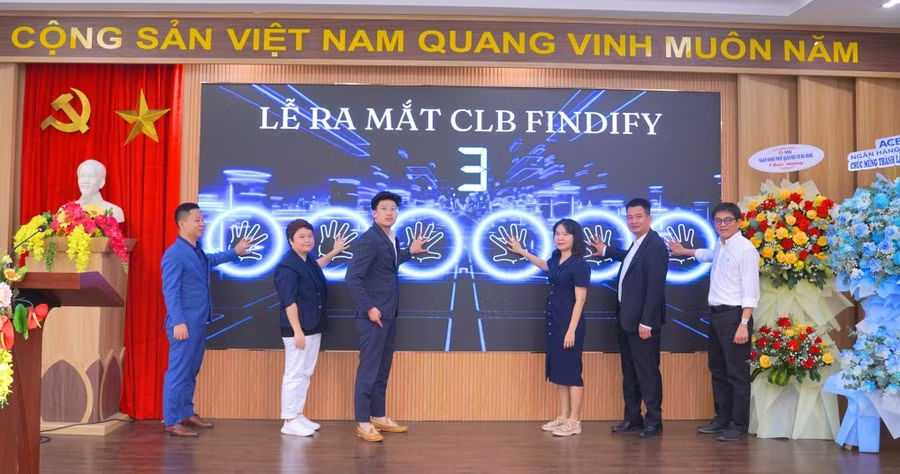
The university has also launched the FinDify Club for students interested in financial technology (FinTech), with participation from multiple enterprises.
Businesses are working alongside the university to co-design curricula, define learning outcomes and professional competencies aligned with the city’s development needs, while expanding co-operative education (Co-op) programmes, internships and graduation projects centred on real-world challenges faced by enterprises and functional zones in Da Nang.
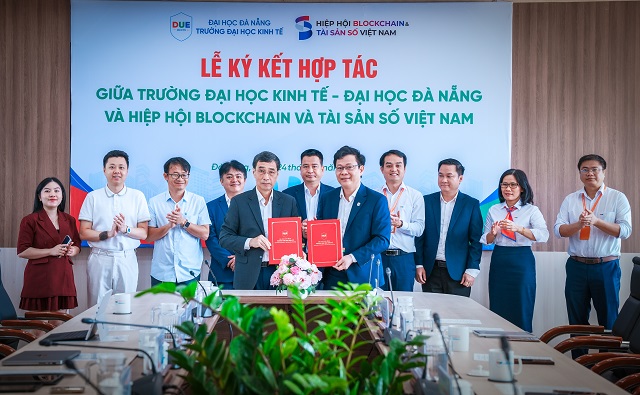
The University of Danang - University of Economics and the Vietnam Blockchain and Digital Assets Association have signed a memorandum of understanding to strengthen ties between academia and the digital technology business ecosystem in training, research and human resource development. Under the agreement, the two sides will jointly implement scientific research, academic exchanges and specialised seminars on blockchain, digital assets and emerging financial technologies, bringing real-world market issues into the academic environment. Advanced training programmes, short courses, seminars and career-oriented workshops will also be co-organised to enhance practical capabilities for students, faculty and the business community.
The partnership will further expand into applied research projects, knowledge transfer and the development of training models aligned with labour market needs. This approach contributes to building an ecosystem linking universities, businesses and knowledge, supporting the goal of establishing an international financial centre in Da Nang.
“Cooperation with organisations in the fintech sector helps narrow the gap between training and market demand. Involving experts and business leaders in teaching and assessment not only enables learners to access real-world practice early, but also creates a direct feedback mechanism from the labour market into education. Students gain early exposure to working environments, thereby enhancing their career adaptability,” said Prof. Le Van Huy, president of The University of Danang - University of Economics.
Source: giaoducthoidai.vn